ART · FLUX IV·FTS 67
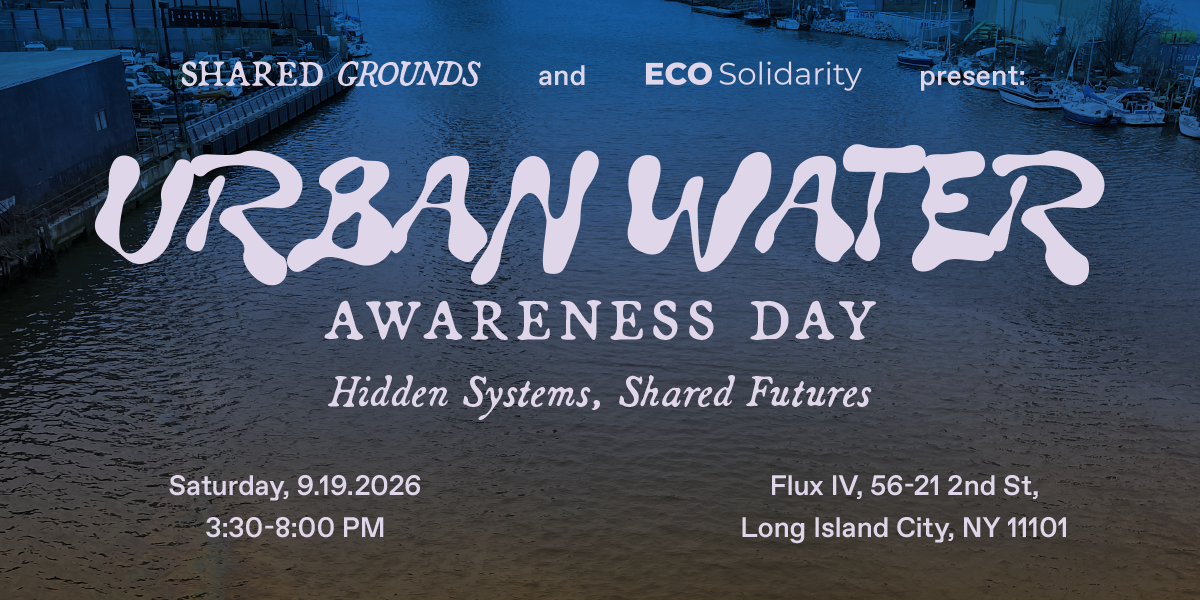
Urban Water Awareness Day
3:30 PM–8 PM
Flux IV
56-21 2nd St, Long Island City
Long Island City, Queens
Free
@
Taking the NYC Ferry at dusk, as glimmering sunrays soak into the East River rippling beneath the fractured reflection of the Manhattan skyline, one is reminded that New York is a city profoundly shaped by water. Beneath its rivers, estuaries, canals, and harbors accumulate submerged layered histories of industry, public life and ecological transformation. What remains beneath the surface?
Urban Water Awareness Day is a public program consisting of an urban waterfront walk, panel discussion, workshop, and film screening presented in conjunction with New York Climate Week. The program brings together artists, architects, urbanists, environmental advocates, and community organizations, to examine water as a civic, social, and cultural framework, not merely a technical system. Through public dialogue, site-based learning, architectural design, and artistic practice, it reflects on municipal water as space for environmental justice, climate resilience, urban policy, and public health alongside models for ecological restoration and climate-adaptive design. This program reveals how water continues to shape everyday life and how some of the city’s most pressing environmental, social, and political challenges converge in the municipal waters of a warming New York City. It is a joint initiative of Shared Grounds and ECO Solidarity, a collaborative project represented by the Finnish Cultural Institute in New York, Flux Factory, and the Polish Cultural Institute New York.
Often hidden beneath streets and woven into the built environment, water infrastructure remains largely invisible despite its profound influence on public health, urban development, and climate adaptation. These systems, ranging from reservoirs and waterways to public pools, waterfronts, and estuaries, have shaped the growth, memory, and daily life of New York City for generations. As rising temperatures, extreme weather events, and aging infrastructure put increasing pressure on urban environments, questions of stewardship and resilience become ever more urgent. Urban Water Awareness Day proves that cultural programs play an important role in this context by making invisible systems visible, fostering public awareness, and encouraging new ways of imagining climate resilience in the city.
In Public Pools research project, Karolina Częczek reimagines New York City’s municipal pools as essential civic and ecological infrastructure beyond their seasonal use. The research explores the history, form, and social and cultural aspects of the swimming pool as an architectural type. The pool serves as a device to engage specific aspects of public space and architectural invention while revealing the undercurrents of urban policy.
The project is illustrated by a catalog of New York City public pools, photographs and writings. Through the NYC Water Map, the project reveals the city’s interconnected watershed, from upstate reservoirs to neighborhood pools, demonstrating how it influences public health, heat mitigation, and everyday urban life. The project also proposes practical, climate-adaptive solutions built upon the city’s existing water systems. These speculative proposals applied to five distinct typologies of New York City pools, ranging from programmatic extensions to architectural interventions, foster use of public amenities and promote climate resiliency.
Expanding this perspective from citywide water infrastructure to neighborhood landscapes, Interval Projects explores how architecture can reconnect cities with ecological systems. The New York–based practice, founded by Marlisa Wise and Benedict Clouette, works at the intersection of architecture, urban ecology, and public space, transforming overlooked sites into resilient civic landscapes. Their work on the Dutch Kills Loop in Long Island City proves how ecological restoration, adaptive design, and public access can reimagine post-industrial waterfronts in response to climate change.
Together, Karolina Częcz
Seen at
What's happened here so far · 000
Nothing yet. It hasn't happened.
Report from this event